
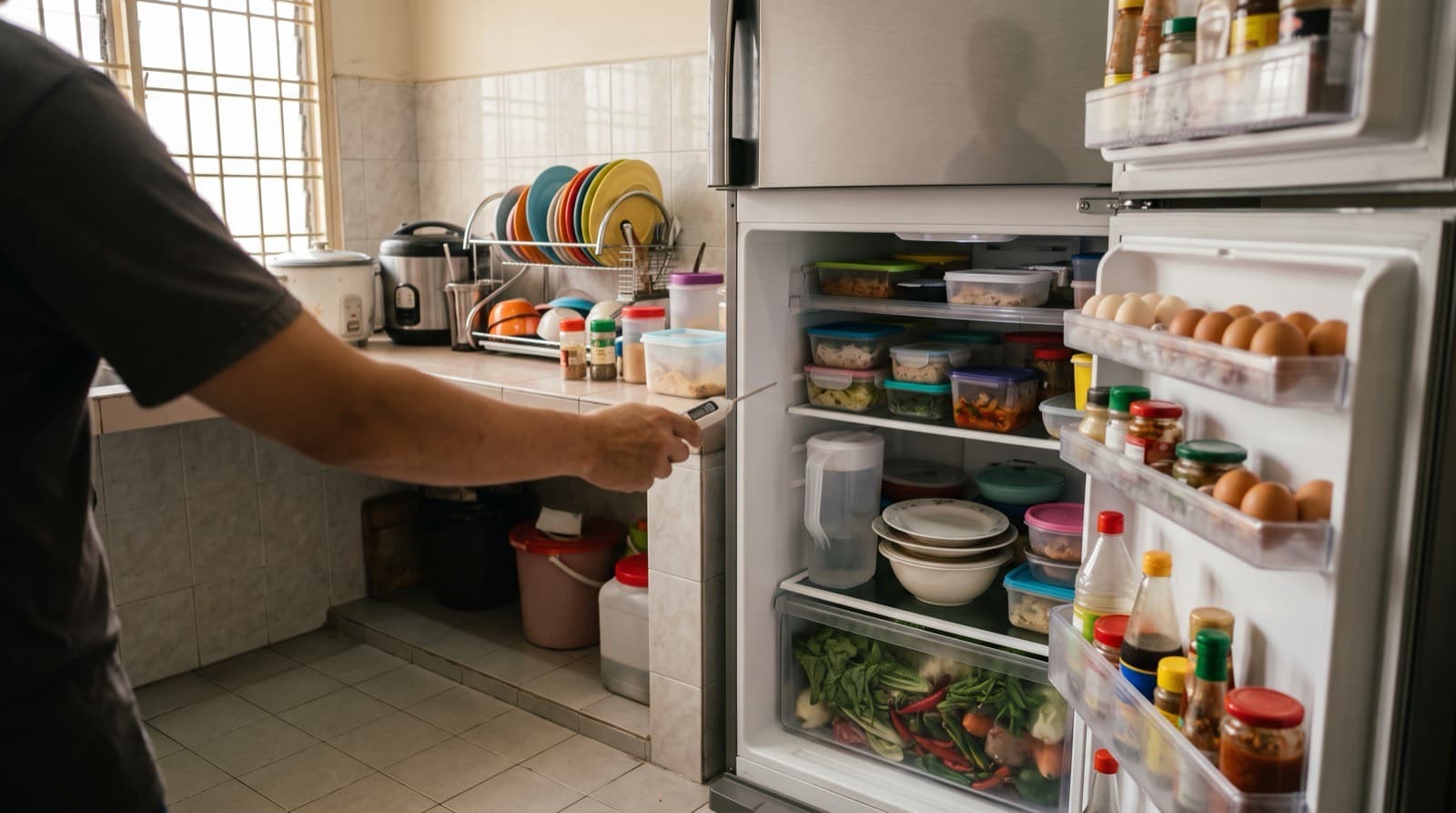
"The freezer is still making ice, but the bottom is not cold." We hear this sentence a lot. It is one of the most common fridge warranty calls we get from homes around Johor, and sometimes the fridge is only a few weeks old. The good news is that some of these turn out to be something you can sort out yourself in ten minutes. The rest need a technician, and it helps to know which is which before you start pulling the fridge apart.
Why the Freezer Can Be Cold While the Chiller Is Not
Most two-door and side-by-side fridges today are frost-free, and many of them have a single cooling coil that sits in the freezer. A fan blows air over that coil, and part of the cold air is sent down a duct into the chiller (the fresh-food section). A small flap called a damper opens and closes to control how much goes through.
So if the freezer is cold, the cooling system itself is working. The problem is almost always the trip the cold air takes from the freezer to the chiller. Something is blocking it, or something that moves it has stopped. Keep that picture in mind and the checks below make sense.
Safe Checks You Can Do, in Order
None of these need tools, and none involve opening anything that is screwed shut. Do them in this order. If one fixes it, give the fridge a few hours and check again.
1. Give a new fridge time
A fridge that has just been delivered starts warm, and the chiller is the last part to get cold, because it only gets the air the freezer can spare. Give it about a day, and up to 48 hours if you loaded it with a week of groceries on the first evening. If your manual gives a different time, follow the manual.
2. Check the chiller temperature setting
Many fridges have separate settings for the freezer and the chiller. Someone may have turned the chiller to its warmest setting while cleaning, or a child may have pressed the panel. Some models also have a holiday or eco mode that keeps the chiller warmer on purpose. Set it back to the middle of the range, or to the default in your manual, and wait a few hours.
3. Clear the air vents inside the chiller
This is the first place we look. Look for the vents (small slots) on the back wall or ceiling of the chiller, usually near the top. A tub of rice, a durian container or a stack of Tupperware pushed right against them will block the cold air completely. Pull everything a few centimetres away from the back wall, and leave space between items so air can move. Keep this in mind before Hari Raya or Chinese New Year, when every fridge in the house gets packed full.
4. Check that the doors close and seal
A door that stays open by a few millimetres lets the cold air out all day. Check that nothing (a tall bottle, a shelf, a drawer) stops either door from closing. Then try the paper test: close the door on a sheet of paper and pull it out. You should feel it drag. If it slides out easily at some point along the door, the seal is not sealing there. Wipe the rubber seal with warm soapy water and check again. A torn or misshapen seal is a part to replace, not something to tape up.
5. Give it room to breathe, and spread out big loads
Fridges get rid of heat into the room. In a hot back kitchen pushed tight into a cabinet, they struggle, and the chiller feels it first. Leave the gap around the fridge that your manual asks for. Split a big pot of leftovers into smaller containers so it cools faster, and avoid loading a lot of warm items at once.
6. Measure, do not guess
Put a food thermometer in a glass of water on the middle shelf of the chiller and read it after a few hours, without opening the door in between. Food safety guidance puts a fridge at 4 °C or below and a freezer at −18 °C. A real number also helps the technician if you need one.
Signs It Needs a Technician
If you have done all six checks and the chiller is still warm, the fault is almost certainly inside the fridge. Call a technician if you notice any of these:
- The chiller is still well above 4 °C after 48 hours with the vents clear and the setting correct.
- A thick layer of ice or frost covers the back wall of the freezer. That often means the defrost system is not working and ice has blocked the air duct.
- No air, or only warm air, comes out of the chiller vents when the fridge is running.
- Water drips or pools inside the chiller, or ice forms around the vents.
- The freezer is starting to get softer too, or the fridge runs non-stop and still cannot keep up.
- New noises: clicking, scraping, a fan buzzing, or silence where there used to be a hum.
These point to the parts that move the cold air, such as the fan, the damper or the defrost heater, or, less often, to the sealed cooling system. All of them are technician jobs.
When It Is a Warranty Case
A chiller that stops getting cold on a fridge that is still within its warranty period is usually a warranty matter: a fan, damper or defrost part that stops working is the kind of fault a warranty is for. The brand's terms decide in the end. Two things help your claim:
- Do not open it up. Leave the panels and parts alone. Signs that someone has opened the fridge can complicate a warranty claim.
- Have the details ready: your Shopee or TikTok order number or your receipt, plus the model and serial number from the rating sticker, usually inside the chiller or at the back. Note what you checked and the temperature you measured.
If you bought the fridge from Tanradio, in one of our showrooms or on Shopee or TikTok Shop, file it on our warranty claim page. You get a tracking number and can follow the claim from start to finish. Some brands handle warranty repairs through their own service centres. When that is the case, we pass your details on and keep following up.
Bought it from us? File a warranty claim — it takes a few minutes and you get a tracking number.
Frequently Asked Questions
Why is my freezer cold but my fridge (chiller) not cold?
In most two-door frost-free fridges the cold air is made in the freezer and blown down to the chiller through a vent. If that air path is blocked — by food packed against the vent, by ice building up inside the duct, or by a damper or fan that has stopped working — the freezer stays cold while the chiller warms up.
What is the first thing to check when a refrigerator stops cooling?
Check that the fridge (chiller) temperature setting has not been changed, then look at the air vents inside the chiller and move anything that is pressed against them. After that, check that the doors close fully and the door seal is clean and not torn.
How long does a new fridge take to get cold?
Give a new fridge about a day before you judge it, and up to 48 hours if you loaded it with a lot of food at once. Follow your manual if it gives a different time. If the chiller is still warm after that, with the vents clear and the setting right, it is time to call for help.
Is my fridge out of gas if only the chiller is not cold?
Usually not. The refrigerant (gas) runs in a sealed system and does not get used up; it only goes low if there is a leak, and a leak tends to make the whole fridge weak, freezer included. If your freezer is still freezing hard, an airflow problem is more likely. Only a technician can test for a leak.
Is a chiller that is not cold covered by warranty?
Often, if the fridge is still within its warranty period and nobody has opened it up. A fan, damper or defrost part that stops working is the kind of fault a warranty is for, but the brand's warranty terms decide, so file a claim with your order or receipt number and we will check it.
Still not cold?
Tell us what you have checked
Send us the model, when you bought it and what you have tried, or bring your questions to your nearest Tanradio branch.
Sources & references
- U.S. Food & Drug Administration, safe fridge and freezer temperatures (4 °C / −18 °C) and why not to overpack: fda.gov/food/buy-store-serve-safe-food/refrigerator-thermometers-cold-facts-about-food-safety
- Tanradio after-sales experience: the checks and warning signs above come from the fridge warranty calls our team handles across Johor. Your fridge's own manual comes first where it says something different.